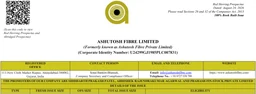
Ashutosh Fibre DRHP & RHP
SMEListedUpdated · GMP, subscription and listing data refresh through the day.
Ashutosh Fibre IPO Details
Market capitalisation is the post-issue share count in the offer document’s capital structure (2,18,74,800 shares) multiplied by the upper end of the price band, ₹92. It is arithmetic on those two filed figures, not a valuation.
Ashutosh Fibre Financials ₹ in crore
| ₹ crore | 2024 | 2025 | 2026 |
|---|---|---|---|
| Revenue | ₹109.87 | ₹114.03 | ₹117.37 |
| Expenses | — | — | — |
| Net profit (PAT) | ₹7.05 | ₹8.51 | ₹16.04 |
| PAT margin | 6.4% | 7.5% | 13.7% |
| Total assets | ₹73.01 | ₹104.6 | ₹112.06 |
Ashutosh Fibre Shareholding before & after the IPO
The founding owners and their group entities.
The post-issue ring is the register this issue’s RHP discloses. Pre-issue register from the RHP capital structure, cross-checked against exchange data. Pre-issue percentages are taken from the disclosure, never estimated.
Ashutosh Fibre Anchor Investors largest allocation first
| # | Anchor investor | Shares | % of book | ₹ Cr |
|---|---|---|---|---|
| 1 | NINE ALPS TRUST- NINE ALPS | 6,52,800 | 37.44% | 6.01 |
| 2 | OPPORTUNITY FUND SINGULARITY | 3,75,600 | 21.54% | 3.46 |
| 3 | NAV CAPITAL VCC - NAV CAPITAL | 3,75,600 | 21.54% | 3.46 |
| 4 | FUND AARTH AIF GROWTH FUND | 2,30,400 | 13.21% | 2.12 |
| 5 | VIRA AIF TRUST- VIRA BHARAT | 1,09,200 | 6.27% | 1.00 |
Ranked by size of allocation; every anchor in an issue pays the same price, so the ranking is the same whether read in shares, rupees or share of the book. Anchor investors are allotted shares one day before the issue opens, at a price fixed on that day, and are locked in afterwards. Read straight from the company’s own Anchor Allocation intimation letter filed with the exchanges — names appear exactly as printed there. Percentages are the filer’s own and total the anchor portion, not the whole issue. View the filed letter
Ashutosh Fibre IPO Lot Size & Minimum Investment by investor category
| Application | Shares | Amount at ₹92 |
|---|---|---|
| Individual investor (min)minimum application | 2,400 | ₹2,20,800 |
The minimum application is 2,400 shares, ₹2,20,800 at the ₹92 cut-off. Since 1 July 2025 SME issues take a minimum application of ₹2,00,000 or more from individual investors; the HNI minimum is set in the RHP. Amounts are shown at the upper band because applications are made at the cut-off price.
Ashutosh Fibre DRHP & RHP offer documents
The draft red herring prospectus is filed with SEBI before the issue; the red herring prospectus adds the price band and dates just before bidding opens. Both describe the business, the restated financials, the risk factors and how the proceeds will be used.
Ashutosh Fibre IPO Strengths & Risks as disclosed in the DRHP
How to check Ashutosh Fibre IPO allotment status
Allotment is decided and published by the issue’s registrar, not by the exchange and not by alphave. For Ashutosh Fibre Limited, the registrar is Kfin Technologies Ltd. — allotment is finalised in the days between the issue closing on 02 Sept 2026 and listing on 07 Sept 2026.
Allotment and refund dates follow SEBI’s T+3 listing timeline in trading days and are tentative until the registrar and the exchange confirm them. alphave does not hold allotment results — only the registrar can show whether an application was allotted.
The registrar publishes allotment on its own portal: KFintech. Your bank will also show the blocked amount released if shares were not allotted.
Ashutosh Fibre DRHP & RHP FAQs
Where can I read the Ashutosh Fibre DRHP or RHP?
The offer document for the Ashutosh Fibre Limited IPO is linked on this page as filed with the exchange; SEBI and the lead managers also host it.
What is a DRHP?
The Draft Red Herring Prospectus is the document a company files with SEBI before an IPO. It describes the business, the financials, the risk factors, the promoters and how the money raised will be used. The Red Herring Prospectus (RHP) is the version filed just before the issue opens, with the price band and dates added.
What are the strengths disclosed in the Ashutosh Fibre DRHP?
The company has unmatched diversity in technical yarns, offering a wide range of products and positioning itself as an industry leader. The company has over 40 years of textile experience, including more than 15 years in technical textiles, making it India's largest manufacturer of polypropylene spun yarns and a pioneer in filtering and technical textile solutions. The company operates modern manufacturing facilities with advanced spinning technologies and state-of-the-art machinery for processing challenging fibers. The page lists all 6 as disclosed.
What are the key risks disclosed in the Ashutosh Fibre DRHP?
The company does not have long-term agreements for supply of raw materials, which could adversely affect its business if unable to procure them. A significant portion of revenue comes from key customers, and losing one or more could negatively impact the business. The company is subject to export obligations under duty exemption schemes, and any inability to comply could adversely affect its business. The page lists all 8 disclosed risk factors.
Ashutosh Fibre IPO Registrar where allotment and refund queries go
The registrar processes the allotment and the refunds. Contact details are as printed in the offer document; the exchange and your broker cannot change an allotment.
How to Apply for the Ashutosh Fibre IPO ASBA and UPI, as SEBI sets them
- Apply through your broker’s IPO window or your bank’s net banking (ASBA). The money stays in your own account and is only blocked until allotment.
- Choose the number of lots and bid at the cut-off price. SME issues take a minimum application of two lots, so the smallest valid bid is the amount shown in the lot table above.
- If you applied through a broker, approve the UPI mandate in your payment app. The mandate must be approved by 5 pm on the day after your bid, and by 5 pm on the closing day for bids made on the last day (02 Sept 2026).
- One application per PAN. A second application under the same PAN is rejected, and both may be.
- After allotment the blocked amount is released for shares not allotted. Allotment and refund queries go to the registrar, Kfin Technologies Ltd., not to the exchange or the broker.
What is GMP in an IPO?
Grey Market Premium is the price at which an unlisted IPO application or share changes hands informally, before the stock is listed on the exchange. It is quoted as a rupee figure over the issue price: a premium of ₹56 on a ₹92 upper band means the grey market is dealing at ₹148.
The grey market is an over-the-counter market between private dealers. It is not operated or supervised by NSE, BSE or SEBI, no trade is settled through a clearing corporation, and no dealer is obliged to publish or honour a quote. Figures are collected by third-party reporters and different sources routinely disagree, which is why a premium can move sharply within a day or vanish entirely once bidding closes.
Grey Market Premium is an unofficial, unregulated over-the-counter datapoint reported by third parties. It is not a price, a forecast, or an indication of listing gains, and is not investment advice.